More Than a Musical
Premiering April 10, the Lehigh University Department of Theatre and Music brings Sondheim and Lapine's Tony Award-winning masterpiece to dazzling life
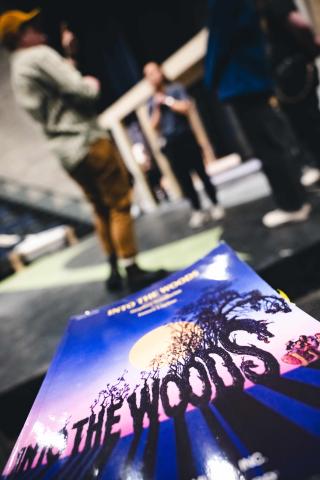
Audiences are walking Into the Woods when they enter Zoellner Arts Center this April. A collaboration between Lehigh’s theatre and music departments is bringing a newly reimagined production of Stephen Sondheim and James Lapine’s acclaimed fairy tale musical to the Diamond Theater.
Into the Woods intertwines familiar tales and characters like Little Red Riding Hood and Cinderella and examines what really happens after “happily ever after.” In its second act—often dark and unsettling—characters learn that realizing their dreams can have unexpected consequences.
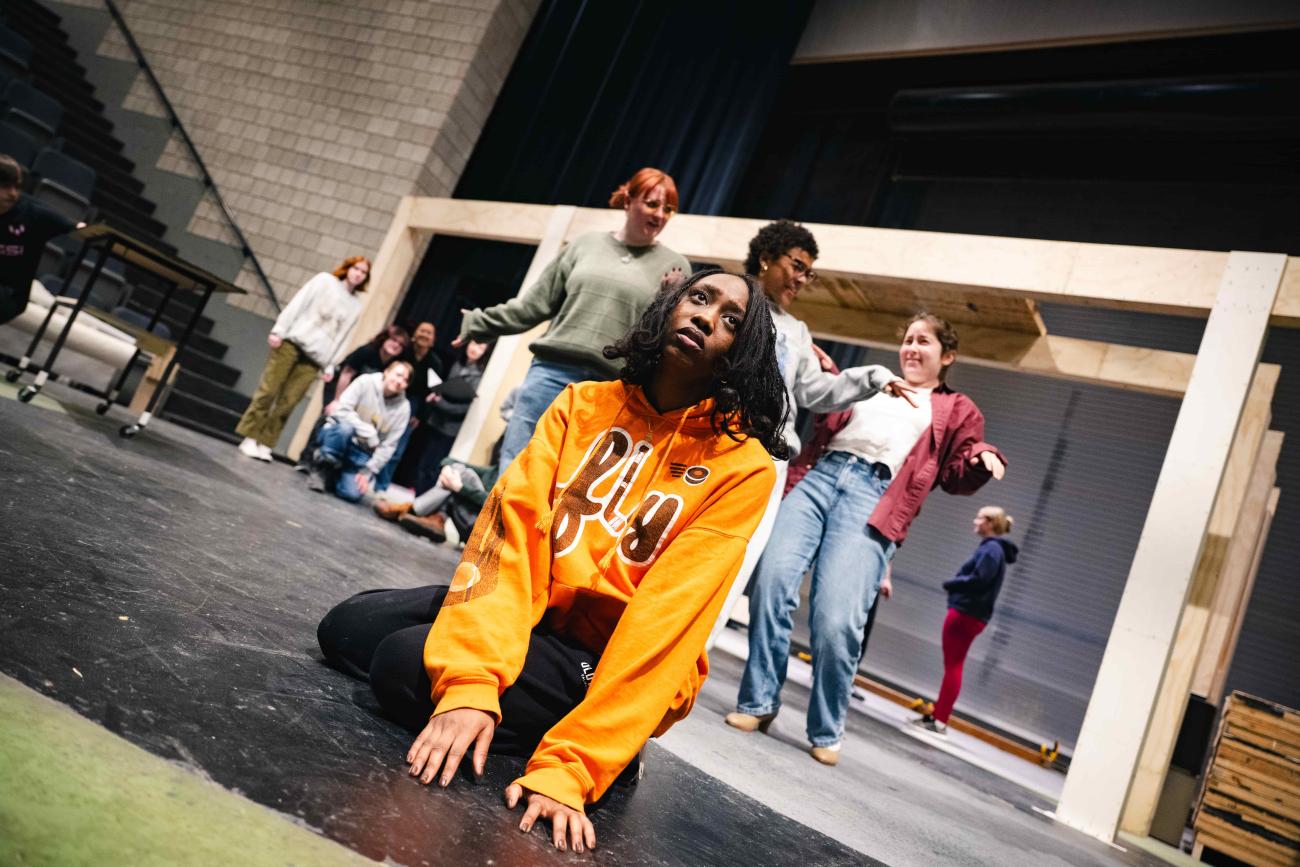
Audiences at Lehigh will see a version developed in a long process that began in summer 2025. Kashi Johnson, chair of the department of theatre, is co-directing the production with Lyam Gabel, assistant professor of acting and directing. They are part of a 10-member production team, five faculty from each department, who have worked together on the show.
“Starting that early and with this commitment has allowed us to do new things that we’ve never done before,” Johnson says. “And the artistry and high standards are shared among all of us.”
A Musical for This Moment
Choosing Into the Woods seemed appropriate, not just for the quality of Sondheim and Lapine’s work, but also for the ways the musical reflects today’s societal issues. Monica Hershberger, associate professor of music, served as the play’s dramaturg, helping to explore its questions with the two directors. “I worked with Kashi and Lyam…to talk through what Into the Woods might mean in 2026.” She notes that, in 1987 when the play premiered, many saw parallels with the AIDS epidemic.
“When asked, Stephen Sondheim admitted that this was not his intention, but he understood why viewers might read [it] in this way. This prompted me to consider how Into the Woods speaks to moments of crisis and rupture—and what those moments might be in the present,” Hershberger says.
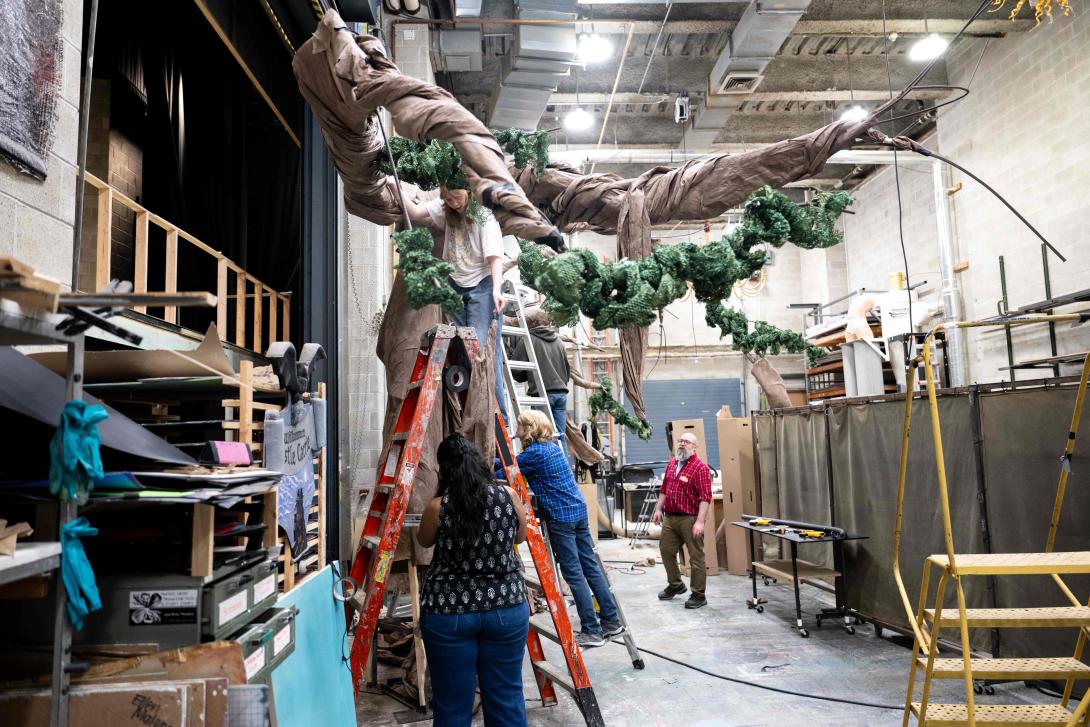
The co-directors say societal issues are central to their creative vision for Lehigh’s production.
Gabel says, “The reason I was so excited about it is because I think it is a play meant for this moment of great instability, politically and economically, where we’re having to deal with the fact that the way we thought the world was may not be the way that the world is….It asks us to not take people at face value, to understand that people have the ability to change, and to understand that the people around you are the people who will be with you to get through it.”
Johnson concurs. “Its themes of community, consequence, and interconnectedness feel strikingly current right now. After years of cultural and social fragmentation, the core message of this musical is that ‘no one is alone,’ ” she notes, her last words alluding to a song near the end of the play’s second act.
Singing Sondheim
Into the Woods’ score displays many of the characteristics synonymous with Stephen Sondheim’s work. Months of practice were required for students to master the composer’s rapid-fire lyrics, irregular rhythms, and shifting harmonies. To ensure they would have enough time to learn the demanding score, auditions were held during the first week of classes in fall. Nearly 60 students auditioned, ready to take on months of rehearsal.
Several students prepared over the summer to audition for the musical’s 20 roles. Amayah Wade, a junior finance major, and Matt Lindley, a senior majoring in bioengineering and computer science in the IDEAS program, both said they spent weeks practicing. “All summer, while I was doing my internship at Vanguard, I’d do whatever I needed to do at work and then come home and practice the songs from Into the Woods as much as I could,” says Wade, who is playing Cinderella.
Singing Sondheim is no small feat, says Lindley, who was cast as the Baker. “I’ve sung Sondheim before, but it is very challenging. When the Baker sets out, he has a list of things he’s trying to find and he sings, ‘a cow as white as milk, a cape as red as blood, hair as yellow as corn, a slipper as pure as gold.’ The last note on each of those phrases is a half-step up each note. But then the second time you sing it, it’s the same pattern of words, but a different pattern of music.”
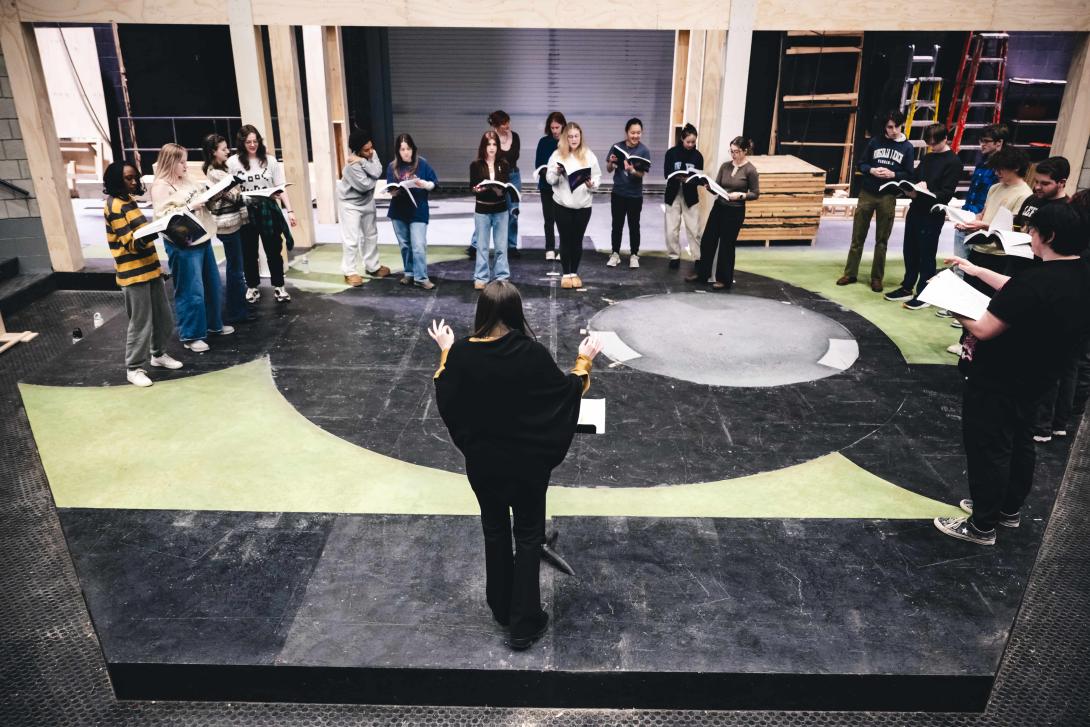
Like others in the cast, Wade and Lindley attended a twice-weekly vocal performance class in fall, taught by the play’s vocal directors—Sarah Frook Gallo, assistant professor and director of choral activities, and Liz Olson, teaching assistant professor and associate director of choral activities. Kyle Wernke, assistant professor and director of the Lehigh Philharmonic, will direct the orchestra. The faculty say the vocal class has many benefits for cast members.
“It really makes for a richer experience for the singers and actors to get to spend all of this time with the minutiae of the score and all of the technical challenges, and to have the space to process what’s on the page and how it relates to their character’s journey,” Frook Gallo says. “You could spend years studying this music and still find new things to think about and talk about. I think that’s what makes Sondheim so special.”
Students’ commitment has been impressive, with groups sometimes meeting outside of class to practice complex songs like “Your Fault,” which involve several characters. “You hear them say as they’re exiting our class, ‘Do you want to practice on Thursday night?’” Olson says.
Collaborating To Create
Collaboration among students was an added benefit of the vocal class. Cast members come from virtually every college in the university. Some are involved in choral activities at Lehigh and others are veterans of past theatre productions. “This is a way for everyone to come together and learn from one another and with one another,” Olson says. “In addition, Sarah and I get to do the same thing with Kashi and Lyam, where we get to learn from them and with them at the same time as we collaborate.”
All 10 faculty involved in the production met as an interdisciplinary team throughout the fall to create the show, with no one department controlling decisions. “Eventually we will come to a shared vocabulary and vision, which makes it so much better,” Johnson says.
Melpomene Katakalos, professor of scenic design and scenic designer for this show, says the group became a kind of “hive mind” to determine a concept for the world of the play. “That’s what I love about being a theatre artist that is so different from any other art form: it’s so highly collaborative,” she says.
One of the challenges the team solved was that musicians and cast must coexist on the stage. Because the Diamond Theater features a thrust stage with audience on three sides, there is no orchestra pit. The result is a multi-level set, with one level forming a kind of bridge over the on-stage orchestra.
Katakalos explains, “They are seen the whole time by the audience and they’re in this kind of thicket of roots. The root system of the forest is an important part of the design, where we actually see the strata of the forest. We see…the canopy, the trunks of the trees and we see below the earth.”

Unlike classic fairy tales, which take place in mythical places existing outside the everyday world, this version of Into the Woodsplaces the characters in an environment that often seems familiar. The woods always are steps away from an urban or suburban landscape denoted by using materials such as concrete, with roots of trees breaking through. Lighting and media design, such as projections, are used to animate the woods. “We will be seeing movement, not just through lighting, but through imagery,” Katakalos says, adding that the set emphasizes a juxtaposition of “the city and the wood coexisting.”
Other trappings typically associated with fairy tales, such as Red Riding Hood’s traditional costume, have received a different treatment that keeps Into the Woods from falling into a cliché. “There is a cloak,” Katakalos says. “But it’s not the cloak you think it is.”
The production may lead audiences to recognize themselves in the characters while also spawning new realizations about what these stories mean, Gabel says. “Audience expectations and cultural imagination are the material we mix and remix in theatre to help people look at things in different ways,” they say.
See the Musical April 10–18
This beloved musical intertwines familiar fairy tales with unexpected twists, exploring the price of wishes and the consequences of choice. A rich and magical journey beyond "happily ever after," Into the Woods is an unforgettable theatrical event for dreamers of all ages.
Get Tickets from Zoellner Arts Center